

Teradata launches autonomous AI and data management platform
Thu, 7th May 2026
Teradata has launched the Teradata Autonomous Knowledge Platform, which brings together its AI, analytics and data tools in one system.
The platform is designed to run across cloud, on-premises and hybrid environments, with the first deployment available through Teradata Cloud.
Autonomous AI push
The launch marks a broader push to position Teradata around what it describes as autonomous AI, where software agents operate continuously with limited human input. The platform is intended to give those systems access to governed business context drawn from structured and unstructured enterprise data.
At the centre of the release is Teradata AI Studio, a single environment for building, managing and governing AI models, agents and applications. It will also be sold separately for organisations that want to use it with existing infrastructure.
Teradata also introduced Tera, a natural-language workspace for business users, developers and data teams. It includes separate modes for data analysis, coding and multi-agent automation.
Another part of the announcement is a set of Tera Agents that handle operational tasks inside the platform. These include agents for sizing compute resources, observing system signals, tracking spending patterns, tuning query execution, and managing provisioning and concurrency.
Cloud deployment
In Teradata Cloud, the platform combines always-on compute with on-demand elastic compute in a managed system. That approach is intended to let exploratory and production workloads run together without moving data into separate platforms.
The Connected Data Foundation, available within Teradata Cloud, brings block and object storage together under a governed architecture. It supports open table formats including Apache Iceberg and Delta Lake, allowing data to be stored once and accessed consistently while customers retain ownership of data and metadata.
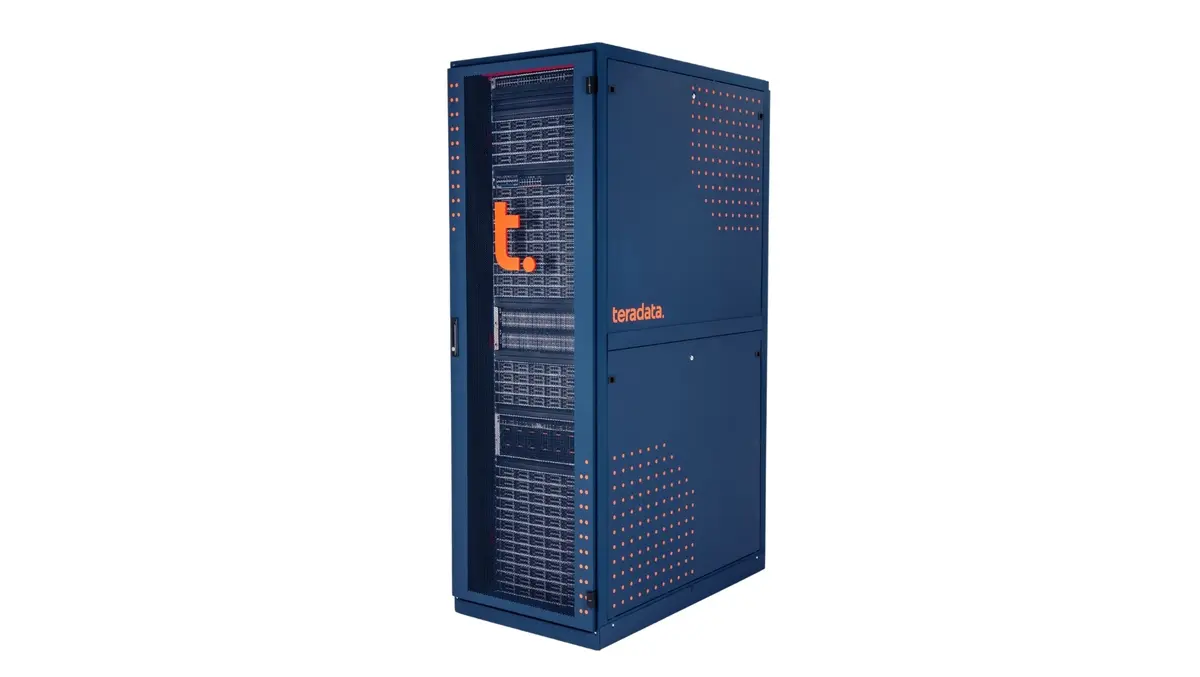
For companies that need to keep workloads on site, the platform will also extend on-premises through Teradata Factory. The offering is aimed at organisations with data residency and regulatory requirements, using Dell PowerEdge servers, NVIDIA AI infrastructure, NVIDIA AI Enterprise software and networking.
Enterprise demand
Teradata framed the launch around rising demand from AI agents, which it said generate far more queries than human users. That is increasing pressure on infrastructure budgets and forcing large organisations to decide where AI workloads should run and how spending should be controlled as usage grows.
Across the enterprise technology market, analysts and vendors have increasingly focused on the challenge of moving AI projects from experiments into routine operational use. Teradata is seeking to differentiate itself by linking AI deployment to the data management, governance and query performance tools it has long sold to large corporate customers.
Use cases cited by the company include natural-language analytics for business users, retrieval agents that search across structured and unstructured data, end-to-end AI and machine learning pipelines, and model lifecycle management covering training, fine-tuning, monitoring and inference.
Teradata is also building partner integrations into AI Studio. Named partners include Karini AI for no-code agent development, Pinecone for vector retrieval, Unstructured for ingesting unstructured data, and WisdomAI for natural-language business intelligence and automated analytical workflows.
Analyst perspective
Sumeet Arora, Chief Product Officer, Teradata, outlined the company's rationale for the launch.
"Enterprises are ready to move beyond AI pilots, but most infrastructure wasn't built to sustain what comes next - autonomous agents that are always-on, never sleeping, continuously turning insight into action. The Teradata Autonomous Knowledge Platform is where every capability we've built to accelerate autonomous AI comes together: unifying data, AI, and analytics into a single system where governance is built in and intelligence scales without operational trade-offs. And it runs wherever the enterprise requires - cloud, on-premises, or both," said Sumeet Arora, Chief Product Officer, Teradata.
Industry analyst Ray Wang also commented on the shift in buyer priorities.
"The real shift is from insights to decisions - and from decisions to automated action at scale. Enterprises moving fastest are already driving 10× gains in speed, cost, and productivity. The ones falling behind are still running pilots. Breaking that cycle means a strong data foundation, outcomes-based AI, and real governance as a single system, not assembled from parts. That's what customers seek in autonomous knowledge platforms," said Ray Wang.
AI Studio and Teradata AI Services are available now across all deployment types, while the Autonomous Knowledge Platform will first arrive on Teradata Cloud. Tera Claw, the multi-agent orchestration mode inside Tera, is set for a research preview by the end of the year.