

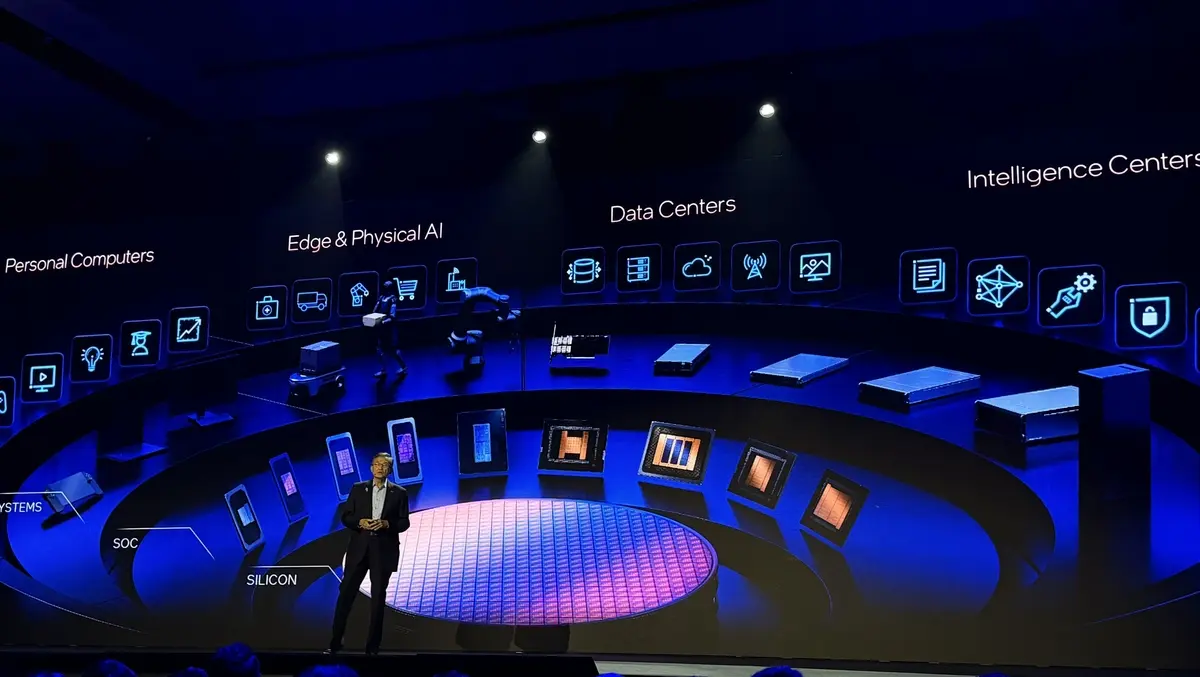

Intel used its Computex keynote to unveil the Xeon 6+ processor and outline new PC, edge and AI infrastructure plans. Chief Executive Officer Lip-Bu Tan and other executives presented the announcements in Taipei.
The clearest product news was the data centre launch. Xeon 6+ will have 288 e-cores, 576MB of L3 cache and will be built on Intel 18A process technology.
Executives tied the chip to a broader argument that AI workloads are reshaping server demand. Intel said inference and agentic AI tasks are increasing the importance of CPUs in coordinating reasoning and orchestration, shifting system design away from the ratios used in large model training.
PC expansion
On the client side, Alex Katouzian, the new head of Client Computing and Physical AI, highlighted the rollout of Core Ultra Series 3, which Intel described as its first product built on 18A. He said the chip is already included in more than 325 consumer and commercial designs.
Katouzian also returned to the Core Series 3 line, introduced earlier for mainstream thin-and-light PCs. He then introduced the Arc G3 series, based on the same architecture as Core Ultra Series 3 and aimed at handheld gaming devices, with availability expected later this month.
Intel used the session to underline the breadth of its PC ecosystem as chipmakers try to show they can address both conventional computing and AI-related uses on end devices. It argued that this spans premium mobile systems, lower-cost mainstream machines and handheld gaming hardware.
Edge push
Katouzian also outlined Intel's ambitions in edge and physical AI. He said 18A already has more than 130 edge designs, while Intel's broader edge network includes more than 4,000 ecosystem partners and more than 100,000 deployments across sectors including manufacturing, robotics and retail.
Intel wants to extend those efforts into what it called physical AI form factors, including robotics, autonomous machines and other AI devices. The pitch places the company in a market where chip suppliers are trying to connect factory systems, robotics and embedded computing with newer AI software models.
Hybrid computing
Tan appeared on stage with Perplexity Chief Executive Officer Aravind Srinivas to discuss hybrid computing, in which inference workloads are split between local devices and the cloud. Intel said concerns about privacy, security, compliance and cost are pushing customers towards that model.
Perplexity has built what it described as a hybrid local server for inference orchestration, designed to move workloads between local and cloud environments depending on device features and available resources. The exchange reflected growing industry interest in keeping some AI processing close to users or corporate data while still drawing on large-scale cloud systems.
Rackscale plans
Much of the keynote focused on how AI could alter infrastructure design at rack level. Intel said research forecasts suggest AI inference workloads could account for nearly 40% of all data centre power demand by 2030, while wider use of agentic AI could sharply increase token consumption.
Tan argued that compute needs to move beyond the socket towards rackscale systems built for inference-heavy environments. Foxconn Chief Product Officer Jerry Hsiao joined him on stage to discuss rackscale AI infrastructure, with Foxconn providing systems integration support alongside Intel and its partners.
Intel also pointed to a recent collaboration with SambaNova, Vista Equity Partners and Cambium Equity on inference systems intended to reduce cost and energy use. During the presentation, SambaNova Chief Executive Officer Rodrigo Liang and Robert Smith of Vista Equity Partners discussed plans for a new inference cloud service called Vector Core Compute, using infrastructure from Intel, Nvidia and SambaNova.
Custom silicon
Beyond standard processors and server systems, Intel used the keynote to stress its role in purpose-built silicon for specific customer workloads. Senior Vice President Srini Iyengar said the company is working with Google on IPUs and with Ericsson on wireless infrastructure chips.
Tan said this approach is also feeding industry-specific work with companies including Hitachi, Siemens, Echo Neurotechnologies and Greenstone Biosciences. He linked those efforts to sectors such as energy, industrial automation, biomedical engineering and drug development, where customers are seeking chips tailored more closely to their computing requirements.
The presentation was a broad attempt to show Intel as active across PCs, edge systems, data centres and custom silicon at a time when semiconductor groups are competing to define the next phase of AI infrastructure. "An Intelligent World Built on Silicon," Tan said.