

Quobly runs silicon-28 quantum wafers at Crolles fab
Thu, 8th Jan 2026
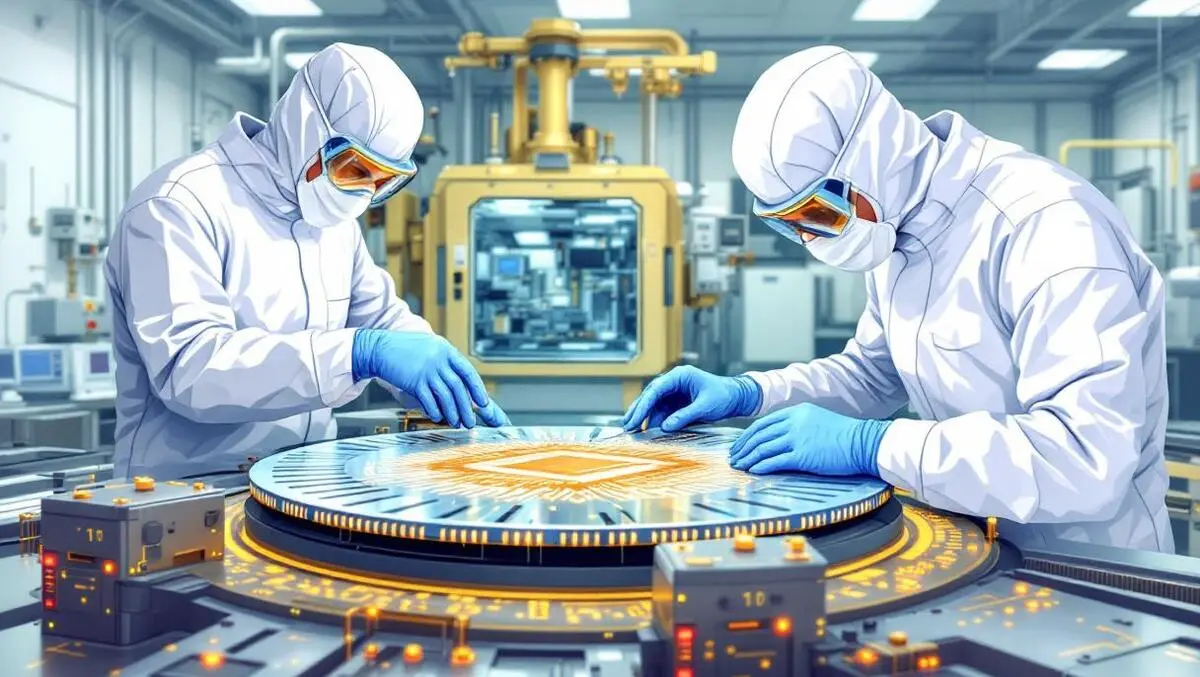
Quobly has begun running its first custom silicon-28 fully depleted silicon-on-insulator wafers through STMicroelectronics' 300mm manufacturing plant in Crolles, marking a new step in the industrialisation of silicon-based quantum processors in Europe.
The wafers are engineered and supplied by French materials specialist Soitec. STMicroelectronics is using its high-volume production lines in Crolles for technology and process development, and for validation of the new substrates.
The project brings together three French-based companies across the quantum hardware chain. Soitec supplies advanced semiconductor substrates. STMicroelectronics provides process development and manufacturing. Quobly focuses on device design and quantum chip development.
Quobly described the first wafers now cycling through STMicroelectronics' fab as a critical step in building a fully integrated supply chain from purified input materials to finished quantum integrated circuits.
The company said this forms part of its roadmap towards "million-qubit" technology. It also said the use of silicon-28 in an FD-SOI architecture represents a first in the field for this specific combination of material and process.
Quobly focuses on silicon-based quantum processors. These processors use quantum dots or related structures in silicon as qubits, rather than superconducting circuits or trapped ions.
Supporters of this approach point to the maturity of existing semiconductor manufacturing as a potential route to scale. That includes access to 300mm production lines, established process design kits, and established tools for yield management.
Purified isotope
The new wafers use silicon enriched in the isotope silicon-28, rather than natural silicon that includes a mix of isotopes such as silicon-29 and silicon-30. The company said the substrates are manufactured on Soitec's industrial lines.
The material is engineered with reduced isotopic impurities. Quobly said this significantly cuts quantum noise in the qubit environment.
The firm said this unlocks single-qubit gate fidelities that approach 99.999 per cent. It described this as a requirement for reliable and scalable quantum processors built on silicon.
Nicolas Daval, Chief Engineering Officer of Quobly, said the progress rests on stable access to the purified material.
"The industrial availability of purified isotope 28 FD-SOI wafers is a game changer for quantum technologies. It allows us to anchor our developments in a solid and proven supply chain from purified gas to quantum chip delivery - a key enabler for achieving our quantum performance targets," said Nicolas Daval, Chief Engineering Officer of Quobly.
Soitec said the development underlines the role of engineered substrates in quantum hardware.
"We are proud to see Soitec's advanced substrates contributing to the emergence of Europe's quantum ecosystem. This milestone illustrates how our expertise in engineering semiconductor materials can enable the next generation of quantum technologies", said Christophe Maleville, Chief Technology Officer, Senior Executive VP Innovation of Soitec.
FD-SOI route
Quobly is combining the 28Si-enriched channel with FD-SOI, which is a fully depleted silicon-on-insulator technology used in low-power and low-noise classical chips. FD-SOI uses an insulating layer beneath a thin silicon film, which gives designers control over electrostatic properties and can reduce variability.
The company said the FD-SOI platform offers CMOS compatibility. It also said this supports a route from initial quantum device prototypes through to larger arrays of qubits produced on industrial tools.
Quobly expects to scale from millions of physical qubits at the device level to thousands of logical qubits once error correction is applied. It said this would depend on manufacturing yields, material quality, and circuit design.
The company links large-scale quantum processors with applications in materials discovery, energy system optimisation and biotechnology modelling. It said these areas stand to benefit from high numbers of high-fidelity qubits.
European ecosystem
Quobly is based in Grenoble and was founded in 2022. It builds on more than 15 years of collaborative research between CEA-Leti and CNRS in quantum physics and microelectronics.
The company's co-founders are Maud Vinet and Tristan Meunier. Vinet is a physicist with a background in semiconductor research and intellectual property. Meunier is a specialist in semiconductor quantum engineering and previously trained under Nobel laureate Serge Haroche.
Quobly has positioned itself as a bridge between academic research and industrial manufacturing in quantum computing hardware. It works within a strategic partnership with STMicroelectronics that covers the industrialisation of its silicon quantum chips.
The startup has attracted early-stage funding for its hardware programme. It raised €19 million in 2023 in what it described as a record European seed round for a quantum hardware company. It secured a further €21 million in 2025 to advance its Q100T programme, which targets fault-tolerant quantum computing.
The current wafers draw on STMicroelectronics' 28nm FD-SOI process as a starting point for process development. Quobly said the first lots are already in fabrication in Crolles.
The partners expect initial performance data from prototype devices on the new substrates in the first quarter of 2026.